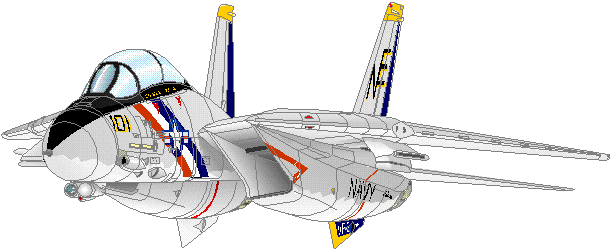
| Further improvements were: |

| The Fatigue/Engine Monitoring System (distributed throughout the aircraft) is a major
Repair & Maintenance improvement. |
|
| AN/APG-71 Radar, multiple target tracking with twice the previous range. The APG-71
can track up to 24 targets simultaneously and uses digital processing instead of analog processing
as used by the AWG-9. |
|
| Joint Tactical Information Distribution System (JTIDS) to secure voice & data communications
links between cooperating assets. |
|
| ALR-67 Radar Warning Receiver, ALQ-165 Airborne Self-Protection Jammer |
|
| ASN-139 Digital Navigation, highly reliable inertial navigation system with enhanced
redundancy |
|
| Infrared Search & Track (IRST), IR heat sensor passively detects & tracks targets,
integrated to provide simultaneous multisensor coordination. The IRST is said to be sensible
enough to detect even heated surfaces on stealthy aircraft such as the F-22. The combination of
the APG-71 radar and the IRST gives the best possible result for target aquisition. |
|
| Cockpit: programmable interactive displays & controls, onboard oxygen generating
system, NACES ejection seats |
|
| Digital Avionics: distributed processing architecture (expandable), two AYK-14 mission
computers, four Mil-std-1553 data busses control all major subsystems |
|
| TARPS: All F-14Ds have the cockpit displays and wiring for use of the TARPS recce pod. |
| The F-14D met also the Navy's alert requirement that the aircraft
should be able to taxi with functioning systems within five minutes of a cold engine start:
The inertial navigation system and the rear cockpit display work within 3 minutes. |
| Furthermore, the F-14s strike capability was re-awakened. Since the
first sketches on the drawing board the F-14 had a strike capability, but back in the early days
there was no need for a "Bombcat". A-6s and A-7s did a good job and the Tomcat could
fly as a pure air-superiority fighter with its unbeaten missile capabilities. Today, F-14A/B/Ds
have full strike capability and gain even more competence in this business.
LANTIRN equipped Tomcats deliver smart bombs as well as standard iron-bombs with a big
bring-back capability. The Tomcat became even night-vision goggle capable and now it is an
absolute long-range multi-mission day & night strike-fighter and reconnaissance platform.
Wow! |
| F-14D Rivals - But things went different for the latest Tomcat version, the
F-14D, due to financial cut-backs and
due to a pro F/A-18E/F lobby in the US government. The procurement number of new F-14Ds was
reduced as well as the remanufacture numbers of aircraft that should have been upgraded from
F-14A/B standard to the F-14D. |
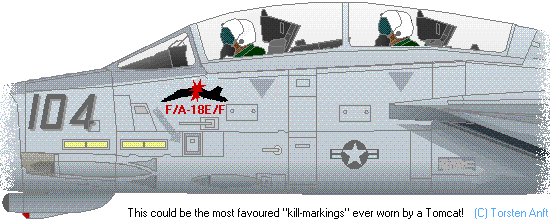
 Finally it happened: A few days after the F-14D
production and remanufacture were terminated on 26 February 1991
, the US Department of Defense announced that the Navy wanted to develop a new version of the
F/A-18 to replace both the F-14 strike-fighter and the aging A-6E. The F/A-18 is basically a light
fighter and so it had to be dramatically modified to fit into the new multi-role. Such considerations
were already made in 1984: These
modifications included a two-man cockpit, upgraded APG-65 radar, enlarged wing-area for better
landing performance, increased internal fuel-capacity (+ 3,000 lbs) and improved F404 engines
with 18,000 lbs of thrust each. All these changes made the F/A-18E/F a new aircraft, but still
the Navy was not satisfied since the Super Hornet did not have the internal volume to carry the avionics, sensors
and countermeasures equipment to be well prepared for the future conflict environment. Further,
even though the F/A-18E/F was somewhat faster than the A-6, the improved thrust could not compensate
the gain in weight and therefore it would lose some of its agility! Even the Super Hornets range
and payload suffered in comparison with the planned A-6F. And back in 1984 the Navy
rejected the F/A-18E/F program... But the light fighter lobby was strong enough and today
the F/A-18E and F are already flying instead of new F-14Ds rolling off the assembly lines... Finally it happened: A few days after the F-14D
production and remanufacture were terminated on 26 February 1991
, the US Department of Defense announced that the Navy wanted to develop a new version of the
F/A-18 to replace both the F-14 strike-fighter and the aging A-6E. The F/A-18 is basically a light
fighter and so it had to be dramatically modified to fit into the new multi-role. Such considerations
were already made in 1984: These
modifications included a two-man cockpit, upgraded APG-65 radar, enlarged wing-area for better
landing performance, increased internal fuel-capacity (+ 3,000 lbs) and improved F404 engines
with 18,000 lbs of thrust each. All these changes made the F/A-18E/F a new aircraft, but still
the Navy was not satisfied since the Super Hornet did not have the internal volume to carry the avionics, sensors
and countermeasures equipment to be well prepared for the future conflict environment. Further,
even though the F/A-18E/F was somewhat faster than the A-6, the improved thrust could not compensate
the gain in weight and therefore it would lose some of its agility! Even the Super Hornets range
and payload suffered in comparison with the planned A-6F. And back in 1984 the Navy
rejected the F/A-18E/F program... But the light fighter lobby was strong enough and today
the F/A-18E and F are already flying instead of new F-14Ds rolling off the assembly lines... |
|
 |
|
| In another development some F-14Ds from VX-4 (todays
VX-9) were redesignated NF-14D to reflect their permanent test configuration. (As of August 1991,
BuNos 163415 and 163416 were redesignated NF-14D) |
|
| There's more... Click here to read more about the Grumman prototype
F-14B, the F-14A+
(todays F-14B), the F-14C and
F-14 derivatives for the future or click below to take a look at the F-14's specifications. |