|
|
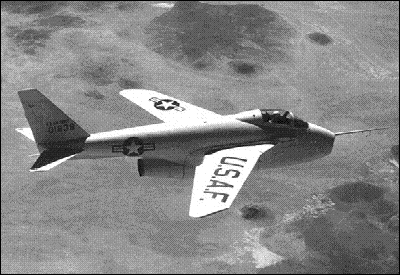
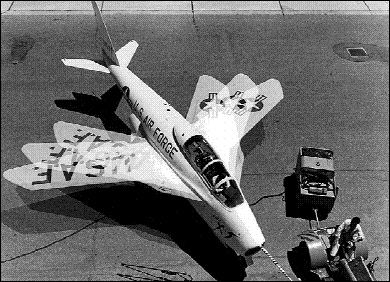 An extract from NASA papers:
"The X-5 (1950 - 1954) was the first aircraft capable of sweeping its wings in flight. (Note
by the editor: The Me P1101's wingsweep angle could only be changed on the ground) It was a
single-place jet-powered aircraft measuring 30 ft in length with a wingspan of 19 feet (with the
wings swept back 60 degrees). The wings could be swept back 20 to 60 degrees. The X-5 weighed
10,000 pounds when fully fueled. An extract from NASA papers:
"The X-5 (1950 - 1954) was the first aircraft capable of sweeping its wings in flight. (Note
by the editor: The Me P1101's wingsweep angle could only be changed on the ground) It was a
single-place jet-powered aircraft measuring 30 ft in length with a wingspan of 19 feet (with the
wings swept back 60 degrees). The wings could be swept back 20 to 60 degrees. The X-5 weighed
10,000 pounds when fully fueled.
"Its mission was to study the effect of wing-sweep angles of
20, 45 and 60 degrees at subsonic and transsonic speeds. Results from these tests provided some
of the design background for the F-111 and the Navy F-14 tactical aircraft. |
 Two X-5's were manufactured by
Bell Aircraft Co. The X-5 was powered by an Allison J-45-A jet engine with a static thrust of
4900 pounds. The maximum speed was 716 mph and the maximum altitude reached was 49,919 feet. The
aircraft was equipped with an ejection seat. Two X-5's were manufactured by
Bell Aircraft Co. The X-5 was powered by an Allison J-45-A jet engine with a static thrust of
4900 pounds. The maximum speed was 716 mph and the maximum altitude reached was 49,919 feet. The
aircraft was equipped with an ejection seat.
"The first flight was completed on June 20, 1951, with Jean Ziegler, Bell test pilot, at the
controls.
"Results of the research program provided a significant full-scale verification of NASA wind-tunnel
predictions for the reduced drag and improved performance resulting from increasing the wing sweep
as the speed of the aircraft approaches the speed of sound. The pilots found they could use the
variable wing sweep as a tactical control to outperform accompanying escort aircraft during
research missions." |
|
| (Origin of above photos unknown ... possibly NASA) |
|
| Back to the F-14 Design Process page! |